






Lockable Gas Spring Selection Guide — Find the Right Type for Your Equipment
Lockable gas spring is not one-size-fits-all. The type you choose determines whether your application feels smooth and cushioned, holds absolutely still, or gives your users fingertip control. This guide walks you through the four main types, shows full specifications, and helps you match the right model to your equipment.
Tell us your load weight, mounting points, and required stroke. Our engineering team will confirm the right locking type, force, and dimensions — then send a factory-direct quotation. Free technical consultation, no minimum order for samples.
Lockable Gas Spring Quick Selection Reference
Before reading the full guide, use the following rules to narrow down your selection of lockable gas springs.
Reference price range for GASTAC lockable gas springs: USD 12–50 per piece, depending on type, force, and stroke. Contact us for an exact quotation.
The Four Types of Lockable Gas Springs
There are four main types of lockable gas springs used across medical, furniture, automotive, and industrial applications: Elastic Lockable Gas Spring, Rigid Lockable Gas Spring, Gas Strut with Lock, and Gas Spring With Latch. Each type solves a different problem. The table below gives a quick parameter overview, and the following sections explain how each one works, where it is used, and what specifications are available.
Rule of thumb: Elastic for cushioning, rigid for zero-drift locking, gas strut with lock for fixed low-cost positions, and gas spring with latch for heavy lids that must not drop.
Type 1 — Elastic Lockable Gas Spring
How It Works
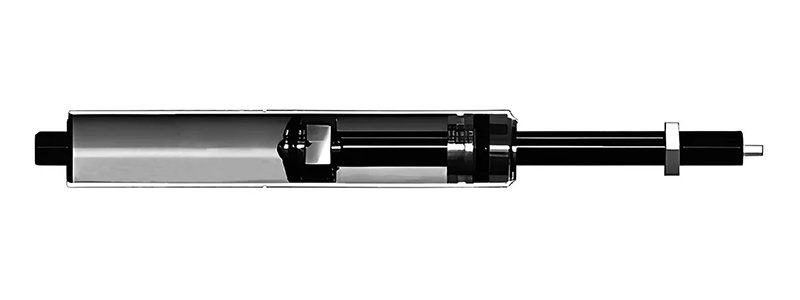
Elastic lockable gas springs use a compressed nitrogen and oil mixture as the locking medium. Because the nitrogen and oil mixture is compressible, the locked position keeps a spring-like elasticity. When the release pin is pressed, the internal valve opens and the piston rod moves freely. Release the pin and the valve closes, locking the stroke at that position. The nitrogen and oil mixture on both sides of the piston provides a gentle, dampened hold rather than a hard stop.
Key Benefits of Elastic Lockable Gas Spring
- Shock absorption: Absorbs sudden jolts and vibration, reducing wear on hinges and mounting points.
- User comfort: Provides a soft, dampened hold for seating and other applications with frequent user interaction.
- Cost efficiency: Simpler internal construction makes it cost-effective for high-volume production.
Typical Applications
Office chair backrest and seat angle adjustment, wall-mounted TV and monitor arms, RV and camper furniture flaps, industrial equipment access panels, pedicure chairs, and reclining seating.
Elastic Lockable Gas Spring Size Chart
Type 2 — Rigid Lockable Gas Spring
How It Works
Rigid lockable gas springs use oil-gas separation as the locking medium. Because the oil is incompressible, the piston is mechanically blocked when the valve closes, so the locked position will not move under load. The locking direction is determined by the medium arrangement: oil in front and gas behind locks the extension direction, while gas in front and oil behind locks the compression direction. This makes rigid locking the right choice for any application where the locked position must not drift, sag, or shift.
Two Locking Directions — Extension Lock and Compression Lock
Rigid locking gas springs are available in two locking directions. Both share the same cylinder construction, the same tube and rod diameters, and the same force and stroke ranges. The only difference is which direction of travel is locked.
Extension Lock holds the load in the extended position and prevents it from compressing under load. When the release pin is pressed, the rod can be pushed back to the compressed position. Typical applications include hospital bed backrest positioning and examination chair height adjustment.

Compression Lock holds the load in the compressed position and prevents it from extending under load. When the release pin is pressed, the rod can be pulled back to the extended position. Typical applications include height-adjustable sit-stand desks and wheelchair tilt systems.

Key Benefits of Rigid Lockable Gas Spring
- Zero drift: The locked position holds firm under load with no sag or shift.
- Safety-critical reliability: Suitable for medical beds, sit-stand desks, and wheelchair tilt systems.
- Direction control: Available in Extension Lock or Compression Lock to match your load direction.
Typical Applications
Hospital bed backrest and leg section positioning, examination and dialysis chair height adjustment, height-adjustable sit-stand desks, wheelchair seating and tilt systems, and industrial equipment requiring locked-position safety.
Rigid Lockable Gas Spring Size Chart
Note: The Elastic and Rigid size charts share the same rod, tube, length, stroke, and force ranges. The difference is the locking medium and the locked feel, not the dimensions.
When ordering, please specify whether you need Extension Lock or Compression Lock. If you are not sure which direction your application requires, contact GASTAC team or email sales@manufacturer.gastac.com with your mounting layout and we will confirm.
Type 3 — Gas Strut with Lock
How It Works
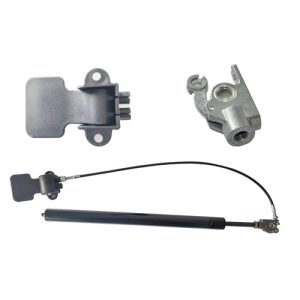
It consists of a standard gas strut and an external metal shroud. When the piston rod fully extends, the heavy outer shroud automatically drops/shifts over the edge of the cylinder due to gravity. This misalignment creates a solid mechanical block that prevents the rod from compressing. To close, simply lift the shroud manually to realign it with the cylinder, allowing normal retraction.

Key Benefits of a Gas Strut with Lock
- Simple mechanism: Fewer moving parts than a latch or release-button model.
- Low cost: Ideal for fixed-position access panels and maintenance covers.
- Reliable hold: No release mechanism means no risk of accidental release.
Typical Applications
Fixed-position access panels, equipment covers that are opened only for maintenance, and lightweight cabinet doors that need to stay open or stay closed.
Gas Strut with Lock Size Chart
Specify lock in extended position or lock in compressed position when ordering. For custom force, stroke, or end fittings, contact us or email sales@manufacturer.gastac.com.
Type 4 — Gas Spring With Latch
How It Works
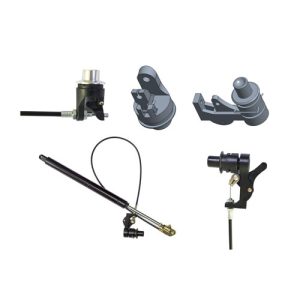
When the gas spring fully extends, a physical, spring-loaded mechanical latch automatically clicks into place or drops into a locking slot due to gravity or spring tension. Once engaged, it creates a solid mechanical stop, preventing the gas spring from compressing under any weight or force. To unlock and close the lid, the user must manually pull a release pin or disengage the latch mechanism. Once this physical block is cleared, the gas spring compresses smoothly.

Key Benefits of a Gas Spring With Latch
- One-hand operation: Quick latch release for frequent position adjustments.
- Precise control: The latch engages at the exact stroke position you need.
- Clean appearance: No protruding release pin, suitable for visible installations.
Typical Applications
Heavy equipment hoods, industrial enclosure doors, machine safety guards, bus engine compartments, boat hatch covers, and any application where heavy lids must be safely secured against accidental dropping.
Gas Spring With Latch Size Chart
Not sure which lockable gas spring fits your equipment?
Send us your load weight, mounting points, and required stroke. Our engineering team will confirm your selection and send a factory-direct quotation.
Get a Free Selection Recommendation
Email sales@manufacturer.gastac.com
Free technical consultation · No minimum order required for samples
Which Type Is Right for You?
Answer these four questions to identify your locking type.
Does the application need cushioning or a suspended feel?
Yes → Elastic Locking Gas Spring · No ↓
Does the locked position need to be absolutely stable with zero movement under load?
Yes → Rigid Locking Gas Spring · No ↓
Does the position need to be adjusted frequently by the user?
Yes → Locking Gas Spring with Release Button · No ↓
Does the position need to be locked only at the end of the stroke, without a release mechanism?
Yes → Gas Strut with Lock · No ↺ recheck Q1
Locking Gas Spring Selection Matrix — Requirement to Type Mapping
Rule of thumb: Match the locking type to the application requirement — elastic for cushioning, rigid for stability, extension/compression lock for load direction, release button for frequent adjustment, and gas strut with lock for fixed-position low-cost applications. If you are unsure, contact our engineering team or email sales@manufacturer.gastac.com.
Common Selection Mistakes to Avoid
Even experienced buyers sometimes choose the wrong locking type. These are the most frequent errors and how to prevent them.
Using elastic locking for a medical bed
The bed will sink slowly under the patient’s weight, because the nitrogen locking medium is compressible. Always choose rigid locking for any application where the locked position must not move.
Using rigid locking for an office chair
Adds unnecessary cost and eliminates the cushioning that users expect. Elastic locking or a release-button model with elastic locking is almost always the better choice for seating.
Confusing Extension Lock with Compression Lock
An extension lock holds the load in the extended position. A compression lock holds the load in the compressed position. If you specify the wrong direction, the spring will not perform as expected. Always confirm which direction your application needs to be locked.
Ignoring the mounting angle
A standard locking spring mounted more than 30 degrees from vertical may fail to lock, generate noise, or wear out prematurely. Specify a separation piston model for any-orientation mounting.
Underestimating force requirements
Leads to springs that cannot hold the load. Overestimating force makes operation difficult. Always calculate F1 based on load weight, geometry, and mounting points. If you are unsure, contact our engineering team or email sales@manufacturer.gastac.com and we will calculate it for you.
Frequently Asked Questions
You May Also Need
- How to measure a locking gas spring correctly, including center-to-center distance and stroke → Technical Support Center
- See how locking gas springs are used in medical and furniture applications → Application Solutions
- Need a custom force, stroke, or end fitting? → Factory Capability & Customization
- Looking to replace Stabilus or Bansbach locking gas springs? → OEM Cross Reference
Request a Selection Recommendation
Send us your equipment details and our engineering team will recommend the exact model, force, and stroke for your application. To get an accurate recommendation on the first reply, please include:
- Load weight in kilograms or newtons
- Mounting point distance in millimeters
- Required stroke in millimeters
- Locking direction, if rigid locking is required
- Operating temperature range
- Mounting angle, vertical or inclined
Free technical consultation. No minimum order required for samples. Contact us or email sales@manufacturer.gastac.com.
Last updated: 2026-09-14




Reviews
There are no reviews yet.